Россия,


СДЕЛАЙТЕ СВОИ УРОКИ ЕЩЁ ЭФФЕКТИВНЕЕ, А ЖИЗНЬ СВОБОДНЕЕ
Благодаря готовым учебным материалам для работы в классе и дистанционно
Скидки до 50 % на комплекты
только до
Готовые ключевые этапы урока всегда будут у вас под рукой
Организационный момент
Проверка знаний
Объяснение материала
Закрепление изученного
Итоги урока

Была в сети 29.10.2026 11:56

Мальцева Екатерина Сергеевна
Учитель английского языка
 1 687
 43 215

Местоположение
Специализация
Фестивали в Англии
Категория:
Английский язык
29.10.2026 09:16

Просмотр содержимого документа
«Фестивали в Англии»
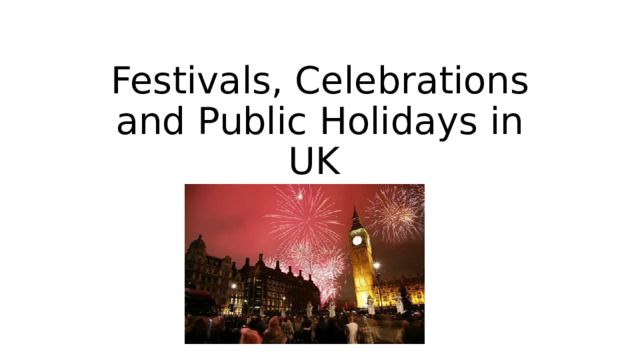
Festivals, Сelebrations and Public Holidays in UK
January
- 1st — New Year’s Day . On New Year’s Eve (31 December), it is traditional to celebrate midnight with your friends or family and to sing ‘Auld lang syne’, a folk song with words by the Scottish poet Robert Burns. The party can last well into New Year’s Day! Many people make ‘New Year’s resolutions’, promising to achieve a goal or break a bad habit in the coming year. In Scotland, the celebration of the new year is called Hogmanay.
- 25th — Burns’ Night (Scotland). Many Scottish people hold a special supper (dinner) on Burns’ Night, a celebration of Robert Burns, with toasts and readings of his poetry. Men might wear kilts, there may be bagpipe music, and people will almost certainly eat haggis (the traditional Scottish dish of sheeps’ heart, liver and lungs) with neeps (turnips) and tatties (potatoes).

- 31st — Chinese New Year. Outside Asia, the world’s biggest celebration of Chinese New Year is in London — there is a parade through Chinatown in the West End, with music, acrobatics and dance performances, a feast of food and fireworks — but there are many more events around the UK. Cities including Manchester, Nottingham, Liverpool and Birmingham usually host big street parties.
- February
- 14th — Valentine’s Day. Love is in the air! Historically the Feast of St Valentine, nowadays this is a celebration of romance. Many people in the UK go out for dinner with their sweethearts, and give them a Valentine’s card, chocolate or flowers. If you’re single, you might receive an anonymous card from a ‘secret admirer’!
March
- Shrove Tuesday or ‘Pancake Day’ (date varies). Lent is the traditional Christian period of fasting, which lasts for 40 days. Shrove Tuesday (or Fat Tuesday) is the day before Ash Wednesday, which opens the Lent, when households use up rich foods such as eggs, milk and sugar.Nowadays, even if they are not religious, many people still make and eat pancakes on this day. Pancakes in England are more like crepes, and are often accompanied with lemon and sugar or golden syrup.
- Ash Wednesday : Date varies. Ash Wednesday is a Christian holiday marking the start of Lent.
- International Women’s Day: 8 March . Very popular in the UK and Europe, International Women’s Day celebrates women essentially, sometimes by giving a small gift such as flowers.
- Mother’s Day / Mothering Sunday : Date varies. Almost always celebrated in March, Mother’s Day in England generally occurs 3 weeks before Easter Sunday. Mother’s Day is a day to celebrate motherhood, and to thank mothers for everything they do for us. Many people give their mothers a card or gift, treat them to a day out or cook a festal meal.
- 17th — St Patrick’s Day (Northern Ireland ). The Feast of St Patrick is a national holiday in Ireland, and is now celebrated by Irish communities all around the world. In the UK, there are St Patrick’s Day events in cities including Birmingham, Nottingham, Manchester and London, as well as Belfast. Many people go out with friends, wearing green or a shamrock symbol (the lucky clover).
April
- 1st — April Fools’ Day. For one day of the year, it is acceptable — even encouraged! — to play tricks, pranks and practical jokes. Even newspapers, TV and radio shows often feature fake stories on April 1. It’s customary to reveal the joke by saying ‘April fool!’ (the person who falls for the joke is the ‘fool’), and to stop playing tricks at midday.
- Easter Sunday: Date varies . In the Christian calendar, Easter is the most holy day of the year as it celebrates Jesus’ resurrection from the dead.
- 23rd — St George’s Day (England). The legend is that St George was a Roman soldier who killed a dragon to rescue a princess. He is now the patron saint of England, and this is England’s national day. You might see St George’s Cross (a red cross on a white background) on the England’s national flag.
- May1 May — May Day . The purpose of May Day is to celebrate the upcoming summer. Summer doesn’t officially begin until June, but May Day celebrates the end of the colder weather and hope for a nice summer. This tradition often includes dancing around a Maypole.
- 5th and 26th — Bank holidays . There are two Mondays in May when people have the day off work or school and (if we’re lucky!) spend some time outdoors enjoying the spring sunshine.
- June14th — The Queen’s Official Birthday . Although the Queen’s real birthday is on the 21st of April, it has been a tradition since 1748 to celebrate the king or queen’s birthday in June. A military parade known as Trooping the Colour is held in London, attended by the Royal Family.3rd Sunday in June — Father’s Day. Father’s Day is a day to show appreciation to fathers, grandfathers, stepfathers and fathers-in-law. Many people in the UK give their father a card or gift, have a meal together or go out for drinks.
3rd Sunday in June — Father’s Day . Father’s Day is a day to show appreciation to fathers, grandfathers, stepfathers and fathers-in-law. Many people in the UK give their father a card or gift, have a meal together or go out for drinks
July
29th — Eid al-Fitr . Marking the end of the month-long fast of Ramadan, Eid al-Fitr is widely celebrated by Muslim communities in the UK. Each community usually organises its own events, but there are some large celebrations and feasts in city centres, such as in London and Birmingham.
August
1st—25th — Edinburgh Festival Fringe. The world’s largest arts festival, ‘the Fringe’ features thousands of shows and performances at 250 venues. Any type of performance may participate, across theatre, comedy, music and dance, and many students visit Edinburgh to put on their first shows.
- 25th — Notting Hill Carnival . Held in west London over a bank holiday weekend, Notting Hill Carnival is Europe’s biggest street festival. Around 1 million people go to see colourful floats and dancers in flamboyant costumes, hear music from salsa to reggae, and taste Caribbean food from street stalls. Bring your party spirit, enough cash and a lot of patience — it can be very crowded.
- September
- London Fashion Week . London Fashion Week sets the fashion agenda, alongside the other big shows in Paris, Milan and New York. These are for industry insiders, but you can get tickets to London Fashion Weekend for a taste of the fashion show experience. There are two each year — the first London Fashion Week is in February.
- October
- 23rd — Diwali. Diwali ( or Deepavali) is the Festival of Lights for Hindu, Sikh and Jain communities. Cities including Leicester (which hosts one of the biggest Diwali celebrations outside India), London and Nottingham have extravagant street parties with traditional food, music and dancing — and of course, displays of lights, lanterns, candles and fireworks.
- November
- All month — Movember. If you’re seeing more moustaches than usual, you’re not imagining it — throughout November, the charity campaign of Movember invites men to grow a moustache and raise awareness of men’s health issues.5th — Bonfire night. Historically, this marks the anniversary of Guy Fawkes’ plot to blow up the House of Lords and assassinate King James I in 1605 — the failed Gunpowder Plot is remembered in the children’s rhyme ‘Remember, remember the 5th of November; gunpowder, treason and plot’. Today, it is commemorated with spectacular displays of fireworks.
- 11th — Remembrance Day (Poppy Day). Known as Veterans Day in the US, Remembrance Day remembers the men and women who died during WWI and WWII, as well as other wars. Throughout the month of November, it is common to see people wearing red poppies as a sign of remembrance. Therefore, Remembrance Day is also known as Poppy Day.
- 30th — St Andrew’s Day (Scotland ). Honouring its patron saint, St Andrew’s Day is Scotland’s national day. There are many events across Scotland, including traditional meals, poetry readings, bagpipe music and country dancing. This is a great opportunity to go to a ceilidh — a party with Gaelic folk music and dancing. Fortunately, there is usually a ‘dance caller’ to teach the steps!
- December
- Hanukkah. In December, Jewish communities across the UK celebrate Hanukkah (Chanukah), the Festival of Lights. In London, the Menorah in Trafalgar Square is the largest in Europe. It’s usually lit by the Mayor of London on the first day of Hanukkah, at an event with free doughnuts and live music.
- 25th — Christmas. Most people in the UK celebrate Christmas, even if they are not religious. There will be Christmas trees, presents, carol singing, mulled wine (warm, spiced red wine), mince pies (small pies with a sweet fruit filling) and if it snows, snowmen and snowball fights! The traditional Christmas dinner is a whole roast turkey with roast potatoes, vegetables, gravy and Christmas pudding for dessert (a steamed sponge pudding with dried fruit) — but each family has its own variations.
- 26th — Boxing Day . The day after Christmas is called Boxing Day, and is a bank holiday in the UK. It’s believed to have been named after the ‘Christmas box’ of money or gifts which employers used to give to servants and tradesmen. Nowadays, there are no particular Boxing Day customs, but most people spend the day with their families, going for a walk, watching sports

Вебинар для учителей
🎓 Свидетельство об участии ✨БЕСПЛАТНО!✨